
Hello, I am
Deepak K. Prajapati
Recognized as a leading computational tribologist pioneering advanced multi-physics models in electrified tribology, TEHL/EHL modeling, electric vehicle motor bearing lubrication, and AI-driven contact mechanics.
Simulating rough surface nanoindentation on Ti6Al4V alloy at UPHF France and advancing open-source EHL solvers and electrostatic discharge (ESD) mitigation in high-RPM EV drivetrains.

Biography & Scientific Trajectory
Bridging continuum mechanics, multiphysics finite element analysis, and experimental tribo-testing across premier institutions in France, Sweden, and India.
Pioneering Reliable, Sustainable Tribology for Next-Gen Mobility
Deepak Kumar Prajapati is recognized among the best computational tribologists and postdoctoral researchers in advanced contact mechanics and electrified tribology. Based at Université Polytechnique Hauts-de-France (LAMIH CNRS-UMR 8201) in Valenciennes, France, he brings over four years of specialized postdoctoral research experience in multiphysics finite element analysis (FEA), advanced contact mechanics, and tribological simulations.
He earned his Ph.D. in Mechanical Engineering from the Indian Institute of Technology Patna (IIT Patna) in 2021, focusing on surface topography evolution under rolling and sliding motion. Following his doctoral studies, Prajapati was awarded prestigious Institute Postdoctoral Fellowships at IIT Delhi (2020–2021) and IIT Madras (2022–2023), before conducting advanced EV bearing research at Luleå University of Technology in Sweden (2023–2025).
His research has pioneered cutting-edge computational solvers for rolling element bearings in electric vehicles—notably modeling electric current-induced lubrication film breakdown, electrostatic discharge (ESD), and transient 3D non-Newtonian mixed-EHL contacts. In close collaboration with Scania CV AB in Sweden, he developed and validated robust industrial models for lubrication-state determination.
At present, Prajapati is spearheading finite element models in Abaqus for rough surface nanoindentation of aerospace-grade Ti6Al4V alloys at UPHF France, seamlessly coupling high-resolution 3D surface metrology with non-linear mechanical material response. His overarching scientific vision is to deliver sustainable, AI-enabled lubrication technologies for next-generation electrified and hydrogen-based energy systems.
Academic Qualifications
Doctor of Philosophy (Ph.D.)
Mechanical Engineering
- Extensive experimental investigations on running-in wear and rolling contact fatigue using a Micropitting Rig (MPR).
- Pioneered electrical contact resistance (ECR) methodologies to quantify real-time metallic asperity contact under mixed EHL regimes.
- Formulated 2D & 3D fractal-based numerical wear models connecting areal surface parameters with macroscopic friction coefficients.
Master of Technology (M.Tech.)
Applied Mechanics
- Formulated non-linear continuum mechanics models for buckling and post-buckling behavior of advanced composite laminates.
- Conducted finite element simulations assessing structural integrity, shear deformation, and fiber orientation effects.
Bachelor of Engineering (B.E.)
Mechanical Engineering
- Graduated with distinction in core mechanical engineering disciplines: Machine Design, Fluid Mechanics, Thermodynamics, and Continuum Mechanics.
Research & Engineering Expertise
Bridging advanced mathematical physics, non-linear continuum finite element modeling (FEA), high-speed electric powertrain tribology, and AI-accelerated predictive solvers.
Transient Non-Newtonian Mixed-EHL
Formulating coupled finite element models (COMSOL Multiphysics) incorporating contact dynamics, Eyring shear-thinning rheology, Patir-Cheng flow factors, and Greenwood-Tripp contact mechanics for counterformal point and line contacts.
- Full-system monolithic Reynolds-elasticity coupling
- Inlet-induced pressure-viscosity wave propagation
- Inertia-induced film thickness fluctuation under transient loading
Electrified Bearing Tribology & Fluting
Simulating sub-microsecond inverter-induced PWM bearing currents, dielectric film breakdown voltage (Vbd), electrostatic discharge (ESD), and electrical erosion mechanisms in high-RPM electric vehicle motor bearings.
- Coupling dielectric breakdown thresholds with transient hmin
- Electrical contact resistance & MTM-EC experimental testing
- Mitigating electrical discharge machining (EDM) fluting & WEC
Surface Metrology & Λ*-Ratio Modeling
Advanced 3D surface topography processing (ISO 25178), summit identification schemes (SID 9-point), reduced peak height (Spk), and asperity radius (β) to determine realistic micro-EHL regime transitions.
- Pioneered Λ* = 1 practical regime transition boundary
- Asperity load ratio (La) vs. real contact area (Areal) convergence
- Statistical roughness modeling across measured isotropic topographies
Non-Linear FEA & Nanoindentation
Constructing multi-scale continuum finite element models in Abaqus coupled with Python automation pipelines to simulate rough surface nanoindentation on aerospace-grade Ti6Al4V alloy at UPHF France.
- Point-cloud to 3D solid FEA mesh interpolation
- Constitutive elastoplastic work-hardening & pile-up behavior
- Intrinsic hardness extraction decoupled from surface roughness
AI & Machine Learning in Tribology
Developing artificial neural networks (ANN), deep neural surrogates, and ensemble regression models trained on high-fidelity simulation databases to predict friction coefficients and contact parameters in sub-milliseconds.
- Physics-informed neural surrogates for multi-scale contact
- Real-time friction and wear regression with <3% relative error
- Instantaneous lubrication regime classification for control systems
FEM-Based Transient Non-Newtonian Mixed Lubrication Model for Rough EHL Point Contacts
Deepak K. Prajapati, Jonny Hansen, Marcus Björling, Roland Larsson • Tribology International 227 (2027) 112808 • DOI: 10.1016/j.triboint.2026.112808
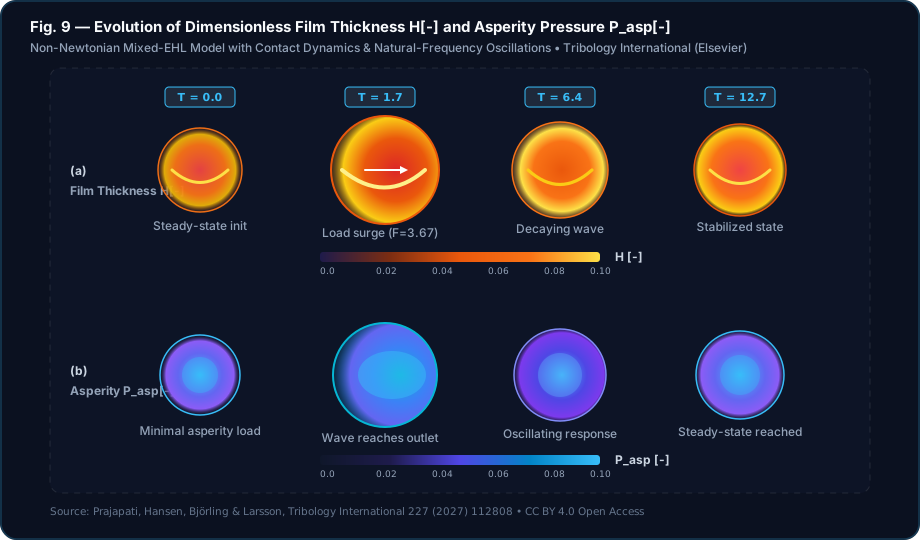
Fig. 9 — Dynamic Film Thickness & Asperity Pressure Wave Propagation
Coupled numerical contour maps at T = 0.0, T = 1.7, T = 6.4, and T = 12.7 capturing the entrapped pressure-viscosity lubricant wave passing through the conjunction under a step increase in load (F = 3.67).
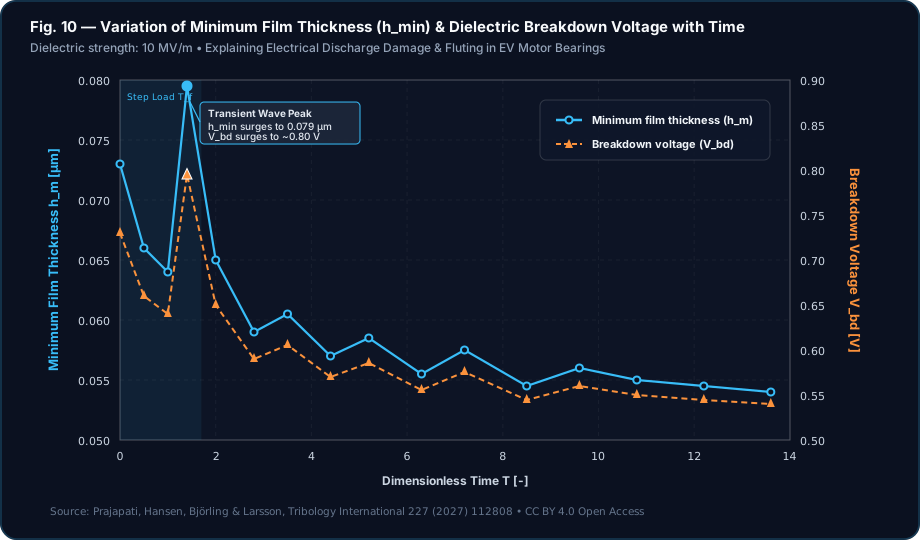
Fig. 10 — Lubricant Film Thickness & Dielectric Breakdown Voltage
Time-resolved natural-frequency oscillation response showing how sudden load steps induce film thickness dips and corresponding dielectric breakdown surges, explaining the electrical fluting damage mechanism in EV motor bearings.
Specialized Research, Publications & Simulators
Access dedicated comprehensive subpages covering verified peer-reviewed publications, industrial EV bearing research, computational simulators, and academic experience.
Research Dossier
Electrified EV bearings, 3D TEHL/EHL solvers, water lubrication & Ti6Al4V nanoindentation.
Open Research Dossier →Publications Catalog
25+ SCI-indexed journal articles with 374+ citations across Tribology International, Wear, and ASME.
Browse Publications →Interactive Simulators
Live Streamlit web app for line and elliptical elastohydrodynamic contact calculations.
Launch Simulator App →Experience & Mentors
Postdoctoral appointments at UPHF France, LTU Sweden (Scania CV AB), IIT Madras, and IIT Delhi.
View Academic Journey →Laboratory & Contact
Direct institutional coordinates, office location at UPHF Valenciennes, and consultation channels.
Contact Deepak Prajapati →